New Approaches to Kindergarten Design: Updated State Building Codes Adopted
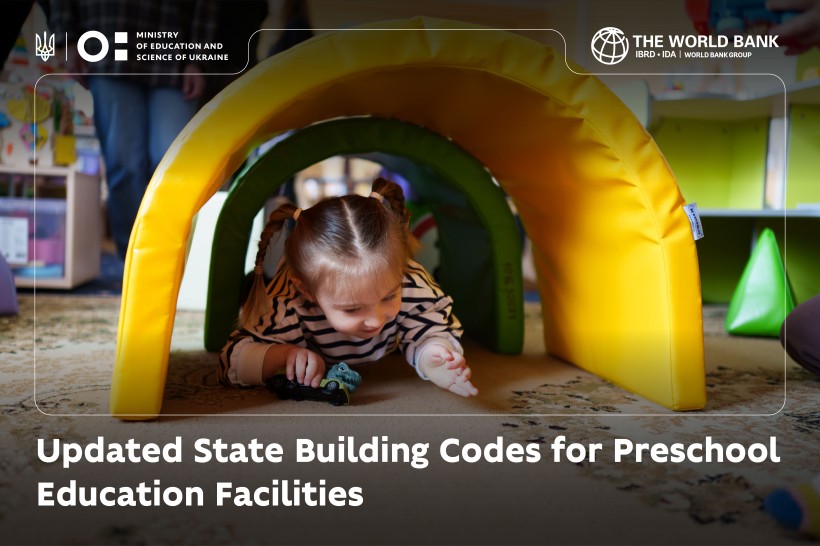
The State Building Codes for Preschool Education Facilities (DBN V.2.2-4:2026) have been updated. The revisions were initiated by the Ministry of Education and Science of Ukraine in cooperation with the Ministry for Communities and Territories Development of Ukraine.
The updated State Building Codes aim to create the conditions for building safe, barrier-free, and modern preschool education facilities, simplify and increase the flexibility of their design, and align regulatory requirements with the new legislation on preschool education as well as European approaches.
Benefits of the Updated DBN for Communities, Businesses, and Architects:
Easier Establishment of New Kindergartens
The new standards shift from prescriptive requirements to more flexible design approaches. In particular, they expand opportunities for the use of multifunctional spaces. This will significantly simplify new construction, reconstruction, major renovation, and the adaptation of existing buildings for use as kindergartens.
Greater Flexibility in Preschool Education Facility Formats
The updated standards allow for the design of smaller-capacity preschool education facilities, making it easier to expand kindergarten networks in smaller communities and densely built urban areas.
Harmonisation with EU Standards
The updated DBNs for Preschool Education Facilities comprehensively incorporate requirements for indoor air quality and ventilation, thermal and acoustic comfort, the safe use of glass, and playground safety. In these areas, the provisions have been harmonised with European design approaches.
This will facilitate the implementation of modern design solutions in Ukraine while creating better conditions for attracting international investment for the construction and renovation of kindergartens.
A Barrier-Free Learning Environment
Requirements for creating accessible, barrier-free environments, including the application of universal design principles, have been integrated throughout the updated DBN. This ensures that preschool education facilities are accessible to all children, regardless of their individual needs or abilities.
New Opportunities for Innovative Architectural Solutions
The updated standards create new opportunities for contemporary architectural solutions in educational facilities that previously lacked clear regulatory guidance.
The document takes into account different playground typologies, approaches to spatial organisation, and natural lighting while establishing clear safety requirements, enabling innovative design solutions without compromising children's safety.
Scope of Application
The updated DBN apply to:
public and private preschool education facilities;
new construction, reconstruction, and major renovation projects.
At the same time, the updated standards do not require already constructed kindergartens to be rebuilt unless they undergo relevant construction works.
Important: The updated State Building Codes will enter into force on 1 October 2026. Communities and project developers should take the following legal considerations into account:
If the design and cost estimate documentation for a preschool education facility has already been completed, the project should undergo expert review and obtain a construction permit before 1 October 2026 in order to proceed under the current regulations.
Projects receiving construction permits after 1 October 2026 will need to update their design documentation to comply with the new State Building Codes.
The updated DBN "Preschool Education Facilities" can be accessed via the link.
The restoration and development of Ukraine's education infrastructure is supported through the Building Forward Better project—a joint initiative of the Ministry of Education and Science of Ukraine and the World Bank, implemented under the LEARN (Lifting Education Access and Resilience in Times of Need) programme.
The Building Forward Better project promotes a transition to modern approaches to educational infrastructure planning, harmonisation of Ukrainian standards with European requirements, the development of standard designs for schools and kindergartens, an investment plan, and a long-term strategy for the development of Ukraine's educational infrastructure.