Around UAH 350 million for free school meals: MoES and the UN World Food Programme continue cooperation
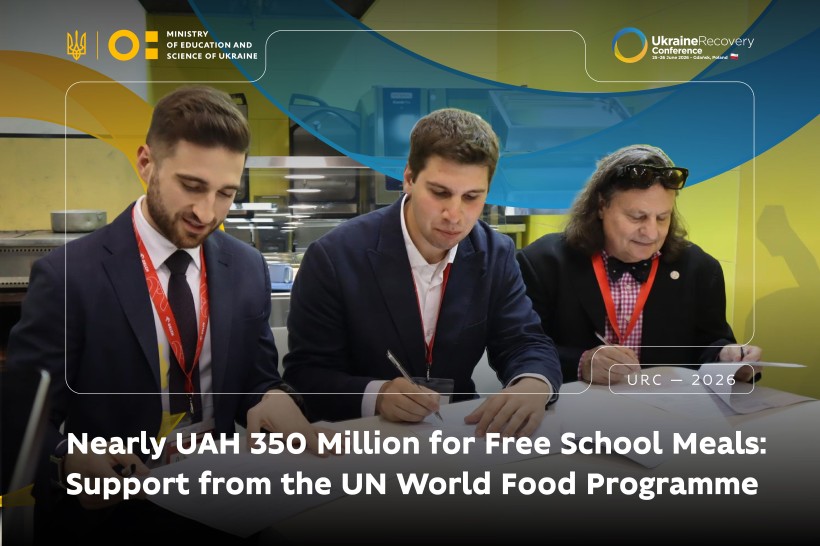
During the Ukraine Recovery Conference (URC 2026), the Ministry of Education and Science of Ukraine and the United Nations World Food Programme (WFP) signed a Financing Agreement for the school feeding programme. The signing took place during the workshop of the Olena Zelenska Foundation, “Safe Schools: Comprehensive Solutions for Ukraine’s Children.”
The document provides for the mobilisation of approximately UAH 350 million to continue ensuring free meals for pupils in grades 1–4 in frontline communities throughout the 2026/2027 academic year.
The funding will be directed to educational institutions in eight frontline regions: Dnipropetrovsk, Zaporizhzhia, Mykolaiv, Odesa, Sumy, Kharkiv, Kherson, and Chernihiv oblasts. This support will help further improve the quality of school meals in line with the standards of the reform launched in 2020 on the initiative of the First Lady of Ukraine, Olena Zelenska.
Also within URC 2026, the Ministry of Education and Science of Ukraine, the United Nations World Food Programme, and the NGO “National Association of Public Catering” signed a Memorandum of Cooperation to further support and develop the school feeding reform in Ukraine.
“For Ukraine, safe and high-quality education remains one of the key state priorities. Despite the full-scale war, we ensure the continuity of learning and continue implementing development reforms across all levels of education. An important component of these changes is the modernisation of the school feeding system. We are grateful to all international partners, in particular the World Food Programme, for supporting this work, which helps ensure that Ukrainian children have access to quality nutrition and comfortable learning conditions despite the war,” said Yevhen Kudriavets, First Deputy Minister of Education and Science of Ukraine.
“School is a safe space for children who have been affected by the war and forced to leave their homes. They have dreams, ambitions, and a desire to build Ukraine’s future,” said Richard Ragan, WFP Director in Ukraine. “That is why there is no better investment in the country’s recovery than ensuring children have access to nutritious food and quality education.”
The World Food Programme is one of Ukraine’s key partners in implementing the school feeding reform. Over the past year alone, the programme reached 275,000 children in frontline regions, providing more than 40 million free nutritious meals. Today, around 2 million Ukrainian schoolchildren already receive free hot meals.
“The school feeding reform is a challenge for any country, as it involves thousands of schools, millions of children, and a wide range of stakeholders. Therefore, meaningful change is only possible when political leadership, the government, international partners, and civil society join forces.
We are fortunate that the reform in Ukraine has the highest-level support thanks to the leadership of the First Lady of Ukraine, Olena Zelenska. Today’s signing of the memorandum is yet another confirmation that partners are uniting around the reform, ready to jointly invest in children’s healthy future,” said Orest Stepiak, Head of the School Feeding Reform Team and Chair of the Board of the National Association of Public Catering.
In addition to providing free meals for pupils, WFP supports the modernisation of school kitchens and the training of professionals. In particular, educational institutions receive modern equipment, and school cooks are trained to work according to new school feeding standards.
The Ministry of Education and Science of Ukraine expresses its gratitude to the United Nations World Food Programme, the Governments of France, Sweden, Finland, and Ireland, as well as the Bestseller Foundation, for their support of Ukrainian children.
The United Nations World Food Programme is the world’s largest humanitarian organisation saving lives in emergencies and using food assistance to build a pathway to peace, stability, and prosperity for people recovering from conflict, disasters, and the impacts of climate change.